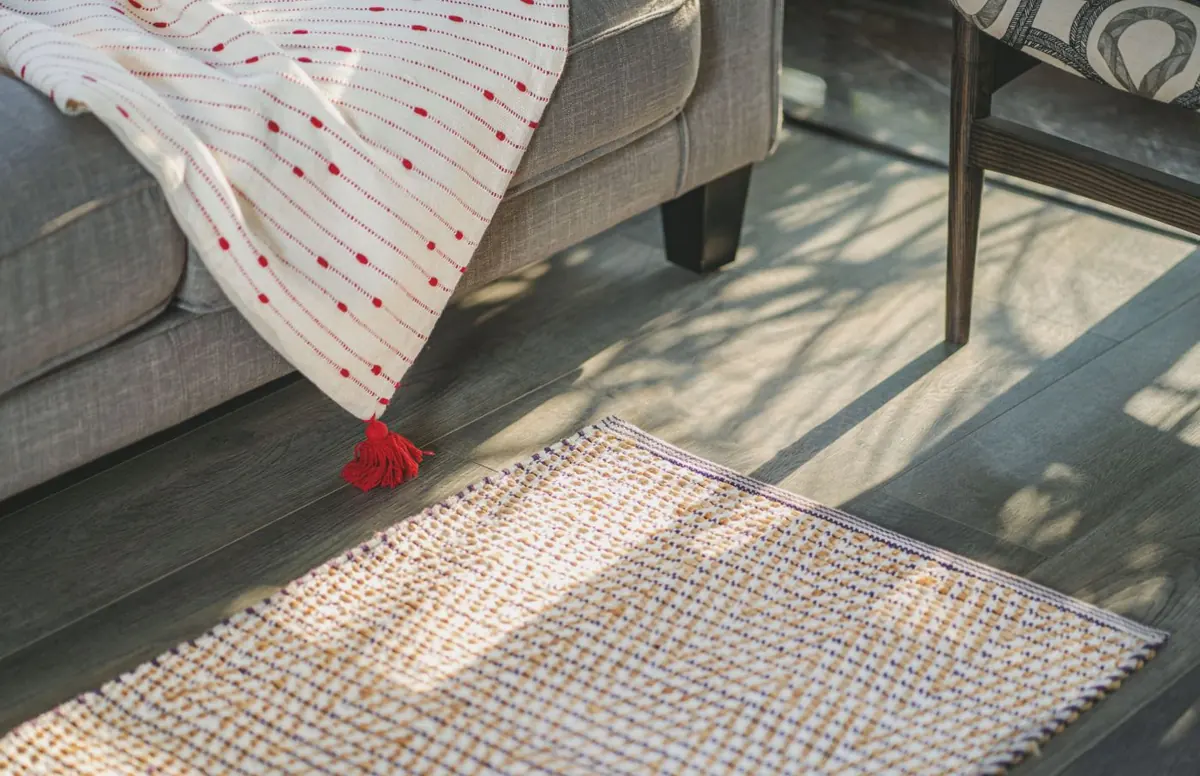
For a small living room, the rug that works is usually the one that makes the furniture feel anchored without swallowing the floor. The most common mistake is buying a rug that is too small: it sits in the middle of the room like a postage stamp, and every chair legs stranded off its edge makes the space look more cramped, not less. The practical fix is to decide the rug size from the seating arrangement first, then check traffic paths, door swings and the one or two functions the room must support every day.
This guide is a researched editorial checklist rather than a record of hands-on testing. It is meant to help you inspect your own room before you order anything, and to make the trade-offs visible so you can choose deliberately.
Start with the problem: a room that feels smaller than it is
In a small living room, the floor is the largest visible surface. When a rug is undersized, the eye reads a boundary that is too tight, and the furniture seems to float. When a rug is oversized, it can block doorways, catch on chair legs, and make the room feel busy with pattern. Both problems come from choosing a rug by style or color before answering a basic layout question: which pieces must sit on the rug, and which pieces must not?
Think of the rug as the place where your seating group lives. A sofa, two armchairs and a coffee table should share the same visual footprint. If the rug only reaches under the front legs of the sofa, it cannot tie the group together.
Checklist: measure the room before you measure the rug
- Mark the door swings. Measure where each door opens and sketch the arc on paper. A rug that sits under an opening door will bunch, slide and eventually trip someone.
- Identify the main walking routes. Note the paths from entry to kitchen, hallway and window. Keep at least a few inches of bare floor or a clean rug edge along these routes so the rug does not become a step.
- List the seating pieces. Write down every chair, sofa and bench that will be used in the room, including the ones you rarely sit in. Their legs determine where the rug edge should fall.
- Check heavy furniture. A bookcase or sideboard on a rug that is too thin can rock, and a low-pile rug under a heavy piece may not be stable. Note which items are fixed in place.
- Note the single anchor point. Most small rooms have one focal element: a window, a fireplace, a television wall or a view. The rug should not compete with it.
Choose a layout pattern based on how the room is used
There are three layouts that tend to work in small living rooms. Choosing among them is less about taste than about how many people sit down at once and whether the room must accommodate a walk-through.
Front-legs-on pattern
Only the front legs of the sofa and chairs sit on the rug. This is the most common layout and the easiest to get wrong in a small room, because it can look sparse if the rug is too small. It works best when the rug is wide enough to reach the front legs of every seat and the coffee table sits fully on it. It leaves more visible floor, which helps the room feel open, but it can make the seating group feel loosely assembled.
All-legs-on pattern
All furniture legs sit on the rug. This creates the strongest visual unit and suits rooms where the seating arrangement is compact. The drawback is size: to fit a full sofa and two chairs on the rug with clearance for passage, the rug may need to be large relative to the room. In a small room, verify that the walk-through paths still have clear floor before committing.
Off-center pattern
The rug sits under one part of the seating group, often the sofa and one chair, leaving the rest of the room bare. This suits rooms with an unusual shape, a window seat, or a corner that needs to feel separate. It is also useful when a room doubles as a passage, because the path can stay clear. Its trade-off is that the rug may look accidental if the edges do not align with a furniture line.
A worked example with a hypothetical room
Imagine a living room that is about three meters long and two and a half meters wide, with a door near one corner that swings into the room, a sofa along the longest wall, and two armchairs facing it across a coffee table. The entry to the hallway runs past the far end of the sofa. In this hypothetical case, the door swing and the hallway path decide the rug’s position. The rug should sit so its near edge clears the door arc, and its far edge leaves a walkable strip beside the sofa. The sofa’s front legs and the armchair legs should all sit on or near the rug, so the group reads as one unit without filling every inch of the floor.
A simple table can help compare options before you buy:
| Question | If yes | If no |
|---|---|---|
| Does a door swing reach the floor area? | Shift the rug or choose a smaller footprint. | Proceed to path checks. |
| Is there a walk-through path? | Keep a clear strip beside the rug edge. | You have more freedom in placement. |
| Do all seats need to sit on the rug? | Choose an all-legs-on size. | A front-legs-on layout may be enough. |
| Is the room used for children or pets? | Consider stability and easy-to-clean materials. | Choose by look and comfort first. |
Common mistakes that make small rooms worse
- Buying by catalogue photo. Photos rarely show the room’s real proportions. Lay painter’s tape on the floor to outline the rug size before buying.
- Ignoring door swings. A rug that looks fine in the middle can block the door once it opens.
- Placing the rug too far under the sofa. A rug that only sits under the back legs disconnects the front of the seating group.
- Choosing bold pattern for a tiny room. Strong pattern makes a small floor look busier. A quieter pattern or texture is easier to live with.
- Forgetting edge stability. Loose edges create trip risks, especially where the rug meets a hard floor. Check how the rug will be secured before it arrives.
Trade-offs and limitations
No single layout fits every small living room. A larger rug may improve the seating group but reduce clear floor. A smaller rug preserves openness but can make furniture look scattered. Pile height affects how easily chairs slide and how stable a table feels, but this varies by the furniture you own. Because you may not have the exact dimensions of every piece, treat these rules as a planning method rather than a guarantee. Measure your own room and test with tape before you commit.
Practical questions to settle before you buy
- Which seats must sit on the rug, and which can stay on bare floor?
- Where will people walk when the room is in normal use?
- Does the rug need to be cleaned easily, or is that less important than softness underfoot?
Caring for the rug you choose
Cover: Pexels photograph, used as an editorial illustration. Stock models and products shown do not imply endorsement or independent product testing. Image license.